I went to the press night of Into The Woods at the Bridge Theatre last night. I’ve seen the 2014 film but never the production on stage, so this was a real treat. The set design was gothically lush, Medievally magic and dark.
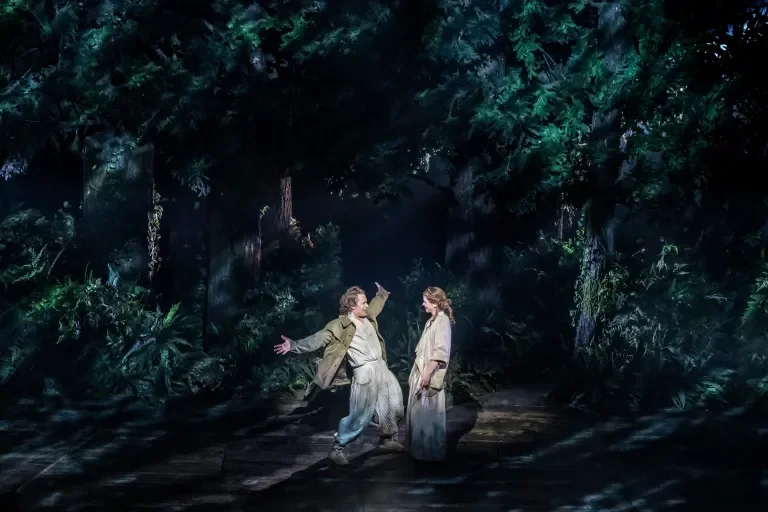
© Johan Persson
Apart from the addition of the baker’s tale, the plot features an amalgamation of fairytales we all know: Little Red Riding Hood, Cinderella, Rapunzel, Jack and the Beanstalk. These are stories we tell again and again.
What surprises me is how much we can feel for a story we already know the end to — how much emotion it can wring out of us with each retelling. I saw Jack Thorne’s A Christmas Carol last year and it did that very thing. My eyes blurred with tears as Ebenezer Scrooge saw the child he once was, and cried,
I don't want him to be me!
When I cried it felt like I was experiencing a new response to this story. What a sucker punch delivered by a character we encounter yearly.
Although we can have new experiences to old stories, I think the appeal of revisiting them isn’t necessarily to find something new within them, but to use them as an assurance that things don’t ever have to change. But Into The Woods subverts our need as an audience for predictability in stories.
The first act of Sondheim’s Into The Woods ends with each character achieving their happy ending: Cinderella and Rapunzel have their princes, Jack his cow, Little Red has been swallowed by the Wolf and survives, the Bakers have their child. With that final tableau, we as an audience are satisfied: our stories have been delivered to us, intact.
And then life goes on.
The second half begins, pushing both the characters and audience forward into the true forest, a deep unknown without the safety net of a tale to be told. What happens next? We were never given this part of the story. This loss of plot/path is symbolised most clearly by the death of the narrator, not far into the first few minutes of Act 2. Now, what once came together for each protagonist in the first act unravels just as quickly. Our heroes and heroines are plunged into a reality (or un-reality) where they must write their own stories, and grieve the endings they believed were theirs forever. The baker loses his wife, Jack loses his mother, Cinderella walks away from her prince and Rapunzel loses everything, taking her witch-mother with her.
Can we be betrayed by our stories? Do we expect them to remain predictable and safe, to never cross the confines of their plot? To assure us that life plays out the same way: a happy ever after is deserved and eternal?
Into The Woods plays with the idea of stories’ futures. It shows one possibility for future within a well-known story: to keep going and write what happens next. The risk there is that we might end up with a new ending we don’t want— the comedy is turned into a tragedy.
For an alternative story future, I think of Anais Mitchell’s Hadestown.
After Orpheus turns around to look for Euridyce, Hermes (who acts as narrator in this story) sings:
It's a sad song
But we sing it anyway
'Cause here’s the thing
To know how it ends
And still begin to sing it again
As if it might turn out this time
I learned that from a friend of mine
The future of the Orpheus and Euridyce story is a retelling. To climb the staircase again and again. Orpheus will turn his head. He will lose. Rinse. Repeat.
In Hadestown, Hermes and the chorus affirm:
It's an old tale from way back when
And we're gonna sing it again and again
The meaning is clear: if we retell this story, we can revert to a place of hope and innocence. The ending will dissolve into something imaginary, even if this retelling is doomed to follow the same path.
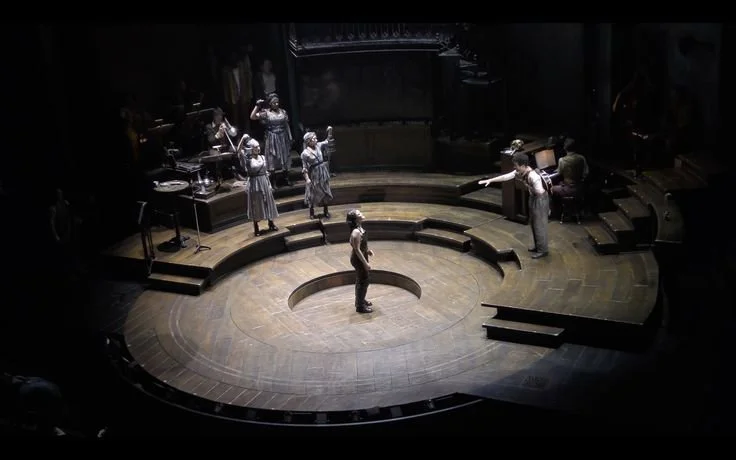
Is that the future of a well-worn story? Is a retelling the only appropriate afterlife for happy ever after? Perhaps this is true— we want the re-setting of the stage, the opporunity to start again, to have hope in spite of what might come next.
See, Orpheus was a poor boy
But he had a gift to give
He could make you see how the world could be
In spite of the way that it is
The most persistent future for these stories is to go back to the start, not to push ahead. Our beloved characters live in a loop, experiencing the same chain of events over and over. That is the most enticing future we readers and spectators can give to them. If we do imagine different futures, none are as compelling as the well-worn groove of the classic tale. The path in the forest always leads to grandmother’s house. Orpheus will always lose.
Even at the end of Into The Woods, a show which explores what lies beyond endings, we go back to the start. Taken from the final song of the musical:
[BAKER'S WIFE]
Just calm the child
[BAKER]
Yes, calm the child
[BAKER'S WIFE, spoken]
Look, tell him the story
Of how it all happened
Be father and mother
You'll know what to do
. . .
[BAKER, spoken]
Shh
Once upon a time...
In a far-off kingdom...
There lived a young maiden...
A sad young lad...
A childless baker...
With his wife...
As I said earlier, I think the appeal of retelling stories isn’t to seek something new, but to seek assurance. Things don’t ever have to change, right? We can just tell the same story over and over, and live in imaginary foreverness. Right?
✶ ✶ ✶
currently: eating fruit pastilles (the red & black ones) click here to to reply via email
✶ ✶ ✶